- The Daily Rocket
- Posts
- Why Smart Luck May Be The Ultimate AI-Era Skill
Why Smart Luck May Be The Ultimate AI-Era Skill
In a world shaped by AI, adaptive people don’t wait for luck, they craft it

Jim Walker
April 19, 2026
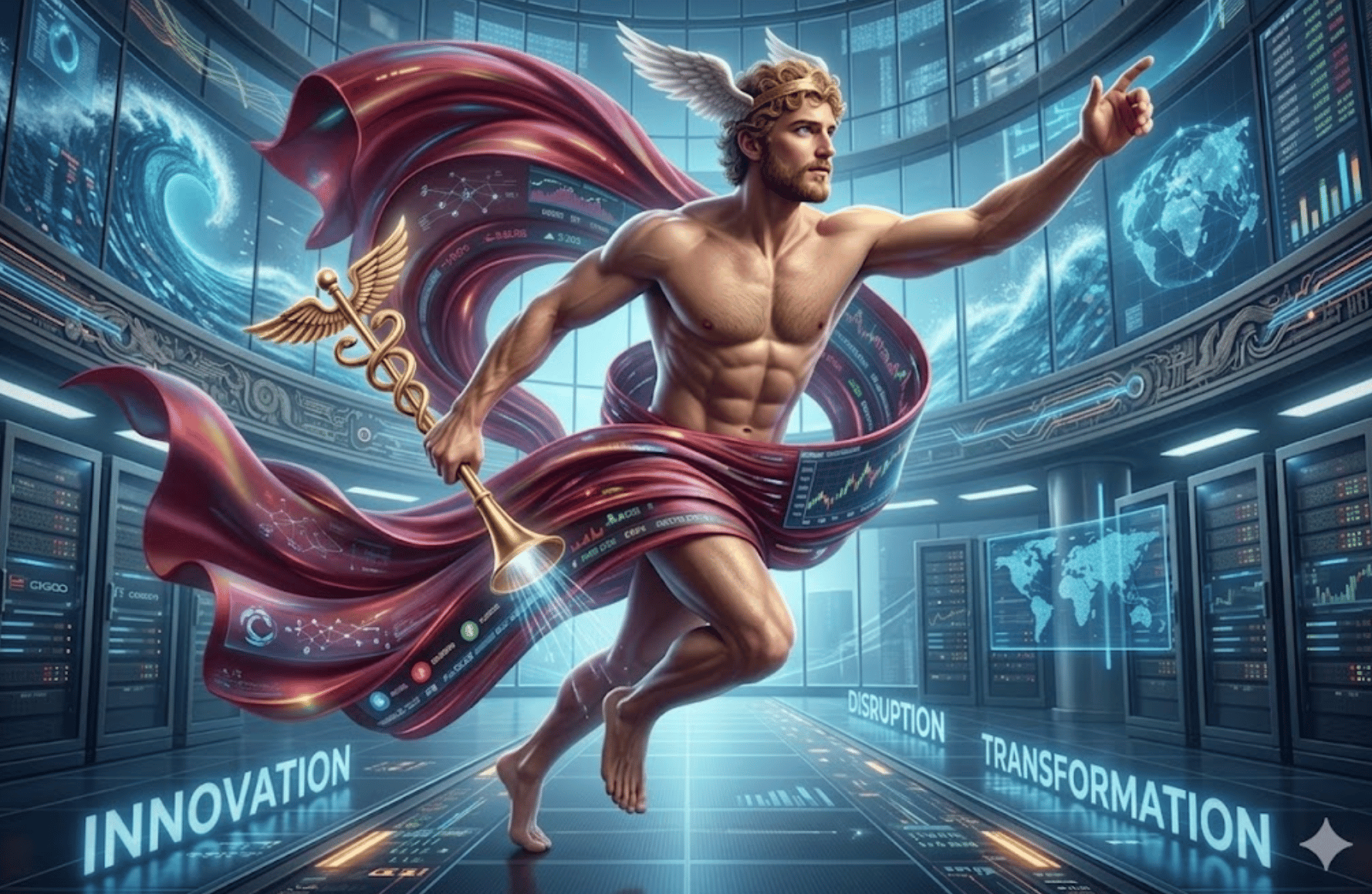
In an age of hyper-accelerating AI, raw strength matters less than adaptive intelligence. The winners are not always the biggest or the loudest, but the fastest learners, the best connectors, the quickest interpreters, and the people most able to turn surprise into value. That is why Hermes - the ancient god of movement, messages, trade, thresholds, and luck is fast becoming the defining mythological figure of our time.
When most people think of ancient gods, they think of power gods. Zeus. Thor. The loud gods. The rulers of storms, sky, thunder, and force. But mythology also preserved another kind of power: agility. Hermes was not the strongest god in the pantheon. He was the swiftest, the most flexible, the most inventive. He ruled movement, communication, commerce, crossings, and lucky breaks. He was the patron of travelers, traders, and clever improvisers - the one who could turn the unexpected into advantage.
In moments of disruptive change, Hermes begins to look less mythical and immensely more practical.
For centuries, we have admired myths of domination: the mighty ruler, the heroic warrior, the wielder of force. But the AI age is shifting the advantage toward a different archetype. Today, the edge is shifting to people who can learn fast, pivot quickly, connect ideas across domains, and act before the moment passes. Success now belongs less to the powerful than to the fluid.
That shift helps explain why an old distinction about luck suddenly feels newly relevant.
We have all experienced what might be called dumb luck - the random break, the chance introduction, the timely opportunity that seems to fall from the sky. Dumb luck can feel magical, but it is unreliable. It arrives unpredictably, and just as often disappears without creating much lasting value.
Smart luck is different.
Smart luck is not passive. It is not superstition. It is not merely being blessed by fortune. Smart luck is what happens when alertness, motion, adaptability, and repeated action combine - Hermes style. It belongs to people who keep venturing out, notice patterns early, experiment from multiple angles, and convert what they find into momentum. They do not simply wait for favorable conditions. They help create them.
This distinction was explored by Lewis Hyde in Trickster Makes This World, his study of the boundary-crossing trickster figures who disrupt stale systems and open new possibilities. Hyde places Hermes at the center of that tradition and draws a sharp line between accidental luck and cultivated luck. His essential point is simple and powerful: smart luck adds craft to accident.
That phrase - adding craft to accident - may be the central key to our moment. Because Hermes does not merely receive luck. He works with it.
In one of the best-known stories, Hermes comes upon a turtle and transforms its shell into the first lyre. That is the essence of smart luck: not stumbling into value, but recognizing value where others see none—and then moving quickly enough to turn it into something useful, beautiful, or influential. Hermes is not lucky in a lazy sense. He is skillful, opportunistic, improvisational, and alive at the threshold where accident becomes invention.
That is no longer just a mythological trait. It is a modern competitive advantage.
AI is multiplying information, accelerating change, and collapsing boundaries between fields, roles, and industries. In that environment, rigid people struggle. They cling to fixed identities, old maps, and familiar methods. Agile people do something else: they learn in motion. They translate across worlds. They test, combine, improvise, and reframe. They do not just endure disruption. They metabolize it.
That is Hermetic intelligence.
It is the kind of mind that sees movement where others see chaos. It notices weak signals early. It treats change as material. It asks not, “How do I preserve the old conditions?” but, “What can I make from what is here now?”
That is also why dumb luck and smart luck diverge so dramatically. One person stumbles into the right room and misses the opening. Another enters the same room, senses a pattern, starts a conversation, spots an unmet need, follows the thread, and creates a chain of outcomes that looks lucky from the outside. But from the inside, it is not random. It is fluid intelligence in motion.
Dumb Luck vs. Smart Luck
Dumb Luck | Smart Luck |
|---|---|
Stumbles into the right place, right time, right people | Consistently ventures out to meet luck on the road |
Waits for the right circumstances | Makes the right circumstances |
Random | Repeatable |
Blind to opportunities already at hand | Always on the lookout for new opportunities and combinations |
Slow to react to lucky breaks | Quick to seize the moment |
Limits number of attempts and approaches | Repeatedly takes action from many different angles |
Believes outside forces are indifferent or hostile to success | Believes movement can create new openings |
If smart luck is the outcome, then Hermetic intelligence is the mindset that makes it possible.
Static Mind vs. Hermetic Intelligence
Static Mind | Hermetic Intelligence |
|---|---|
Clings to one method | Adapts methods to the moment |
Waits for certainty | Learns by acting and adjusting |
Sees change as a threat | Sees change as information |
Misses unusual combinations | Connects ideas across boundaries |
Focuses on what is missing | Uses what is available |
Reacts slowly to new patterns | Detects signals early |
Protects identity at all costs | Evolves identity as needed |
Needs perfect conditions | Creates momentum in imperfect conditions |
Treats luck as external | Co-creates luck through motion and awareness |
Becomes cynical under uncertainty | Stays curious under uncertainty |
This may be the real shift happening beneath the surface of the AI age.
The mythology of force is giving way to the mythology of adaptation.
The old fantasy was that success belonged to the strongest person in the room. The new reality is that success increasingly belongs to the person who can interpret fastest, combine most creatively, move most fluidly, and keep learning while the landscape changes. AI can generate outputs at astonishing speed, but it still amplifies a deeply human advantage: the ability to sense meaning, improvise under pressure, and make wise use of what appears.
In that sense, Hermes is not the god of technology. He is something more useful: the patron of adaptive advantage.
He reminds us that power is not always domination. Sometimes power is translation. Sometimes it is timing. Sometimes it is pattern recognition. Sometimes it is the willingness to cross a boundary others are too rigid to approach. Sometimes it is the ability to turn an accident into an instrument.
That is smart luck.
And perhaps that is why Hermes matters again now. In a world flooded with tools, speed, noise, and disruption, the winners will not simply be the strongest or the loudest. They will be the most agile. The most awake. The most willing to move, notice, connect, and create.
ROCKET Prompt
“If Hermes were my guide for the next 30 days, how could I become more fluid instead of more forceful? One at a time, consider these questions…”
https://rocketprompt.io/smart-luck
This week, trying acting like Hermes at least once. Start one conversation, test one idea, explore one unexpected path, or recombine one overlooked asset into something useful. Do not wait for luck to arrive. Meet it on the road.
The future doesn’t belong to those who wait for luck,
but to those agile and smart enough to craft it.